Datanami
 EnterpriseAI
 HPCwire Japan
 QCwire
 HPC & AI Wall Street
European researchers have developed a cloud computing platform for robots
In order for robots to become effective and efficient, they need to be able to share knowledge and information in a way that is similar to how humans collaborate, by networking. This is the basis for an emerging field known as cloud robotics. But in order for this new robot communication paradigm to be realized, the process must be formalized, and that’s the goal of the RoboEarth project.
 RoboEarth is essentially a World Wide Web for robots. As the project website explains, it is “a giant network and [Hadoop-based] database repository where robots can share information and learn from each other about their behavior and their environment.”
The project began in 2010 with a four-year funding award from the European Commission’s Cognitive Systems and Robotics Initiative. The RoboEarth team, comprised of a multi-disciplinary partnership of robotics researchers from academia and industry, were tasked with developing an open-source cloud platform and several proof-of-concepts to demonstrate the project’s effectiveness.
The research team has now unveiled the first public release of that cloud platform. Rapyuta, the RoboEarth Cloud Engine, is an open source Platform-as-a-Service (PaaS) framework for robotics applications. “Rapyuta” refers to the “Castle in the Sky,” the fabled robot homeland in a Japanese film by Hayao Miyazaki.
 |
|
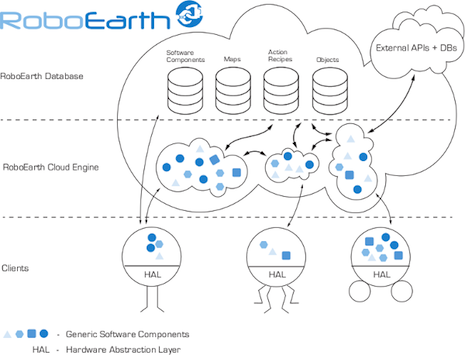
| The RoboEarth architecture: RoboEarth’s WWW-style database offers high-bandwidth connections to robots’ cloud computing environments in the RoboEarth Cloud Engine. Source: RoboEarth | |
Rapyuta opens up a world of information to robots. Connected machines can use the service to offload heavy computation and search for needed information.
“The RoboEarth Cloud Engine is particularly useful for mobile robots, such as drones or autonomous cars, which require lots of computation for navigation,” reports lead researcher Mohanarajah Gajamohan, from the Swiss Federal Institute of Technology (ETH Zurich). “It also offers significant benefits for robot co-workers, such as factory robots working alongside humans, which require large knowledge databases, and for the deployment of robot teams.”
As the short video below explains: “The smarter we want our robots to be the more computation and memory they need. This means our robots are often heavy and expensive; that’s a problem. There’s a better way. This new way means moving and that means moving some of that computation away from our robots and into the cloud and that makes building robots much easier.”
The RoboEarth team will be leading a Cloud Robotics Workshop at the EU Robotics Forum, March 19-21, Lyon, France. They’ve also written a paper further detailing the design and implementation of Rapyuta.