Datanami
 EnterpriseAI
 HPCwire Japan
 QCwire
 HPC & AI Wall Street
There’s been some interesting speculation involving a popular GPU vendor and a certain Internet-bookstore-turned-cloud-provider. According to this piece published on Oct. 4, Amazon purchased more than 10,000 NVIDIA Tesla K10 boards for its AWS EC2 cloud.
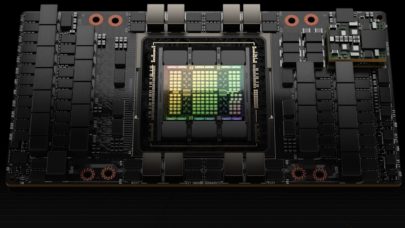
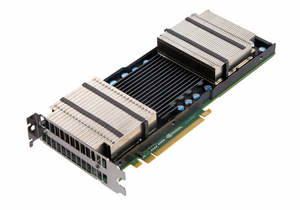 While normally these boards, which pair two “Kepler” GK104 GPUs with 8GB of GDDR5 memory, sell for around $4,000, Amazon is said to have negotiated the price down to somewhere between $1,499 and $1,799 per card, bringing the total amount paid (or allegedly paid) into the $15 to $18 million range.
But there’s more: Amazon reportedly subscribed to a warranty program worth almost as much as the GPGPUs. For an extra $500 per board per year, NVIDIA will immediately replace any faulty units. The two-year deal brings the total contract price up to a cool $25-28 million.
The author who made these detailed claims based them on “sources close to the company.” He added that while NVIDIA was mainly interested in the single-precision K10s they’re also looking at buying some K20 boards for the subset of HPC users who require double-precision performance. This K20 is the same GPU inside petascale behemoths like Titan and Blue Waters. It has a lower retail price of $3,199, but due to high demand, significant volume discounts are difficult to come by.
Are the rumors true?
If the buy happened, why not shout it from the rooftops? It’s a win-win for both companies. For Amazon, it gives cred to the HPC cloud model and affirms the company’s 2010 decision to enter the GPU supercomputing space. And for NVIDIA, this is a huge single-customer sale, even taking into account the volume discount. There’s even speculation that NVIDIA’s stock price has been influenced on the basis of this story alone.
The level of detail in the source article belies the usual rumor mill pap. The author even mentioned that the boards “look a bit different” from the standard issue press photo. And there’s a logic to the story – it certainly could be true. Still, this is essentially an unvetted piece, one that our source at NVIDIA denied and our AWS contact was unwilling to comment on. Perhaps NVIDIA and Amazon signed a non-disclosure agreement. Maybe one or both are planning a grand announcement and don’t want to spoil the surprise.
For the record, a number of NVIDIA partners are making the power of GPUs available as a service. Amazon Web Services, PEER1/Zunicore, Nimbix, SoftLayer and Penguin Computing all offer GPU-based supercomputing on-demand.
As is stands now, Amazon’s Cluster GPU Instance comes with a pair of NVIDIA Tesla M2050 “Fermi” chips, each of which contains 448 CUDA cores and offers 1.03 teraflops of single-precision floating point performance with 148 gigabytes per second of memory bandwidth. The Kepler architecture, which fits two Tesla K10 GPUs on a single accelerator board, has 3,072 cores total (1,536 per GPU) and delivers an aggregate 4.58 teraflops of single-precision performance and 320 gigabytes per second memory bandwidth.
Amazon will need to upgrade its GPU offering sooner or later, and Kepler is the logical choice if they want to stay current to the needs of high-end users.