Datanami
 EnterpriseAI
 HPCwire Japan
 QCwire
 HPC & AI Wall Street
Cloud services carry the lure of cost savings and reduced maintenance concerns. Although the advantages are obvious, potential adopters may be skittish about migrating over security concerns. While stories of blunders have made big news, a new study shows a number of organizations feel more secure with their applications in the cloud.
 Last year, Gartner’s Jay Heiser compared the prospect of cloud applications with storing money in a bank. Essentially, he argued that even though banks are on less stable ground, they still offer a number of protections to their clientele. Regulations and risk transference mechanisms were installed to increase consumer confidence in their financial institutions. Heiser claimed that cloud providers lack these kinds of protections while in-house IT groups possess a number of options to safeguard their organizations.
“The suggestion that the avoidance of public cloud computing is tantamount to keeping your life savings in a mattress is a deeply flawed one, if not an outright lie,” he wrote.
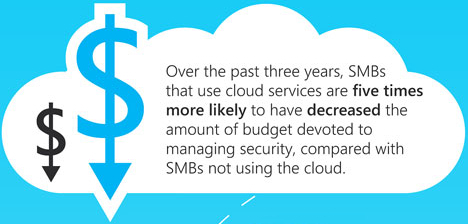
Heiser’s concerns, while valid at the time, appear to be less relevant today. According to a recent study conducted by Microsoft’s Trustworthy Computing group, 35 percent of small-to-medium businesses (SMBs) surveyed after migrating to the cloud, reported higher levels of security. Furthermore, 32 percent of respondents also spent less time managing security risks post migration. Cloud users were also five times more likely to have reduced security management costs.
The study’s authors noted that SMBs were able to reinvest capital saved into growth and development:
“Of SMBs that use the cloud, 41 percent said they were able to employ more staff in roles that directly benefit sales or business growth, 39 percent invest in more product development or innovation, and 37 percent experienced improved agility and competitiveness.”
More than half of those surveyed (52 percent) said using the cloud enabled them to add new products and services more quickly and securely.
 Microsoft uses Skywire, a Nevada-based mobile content distributer, as a prime example. The company admitted security management was challenging and time consuming. After migrating to Windows Intune, the COO reported a 70 percent reduction in support calls while saving $90,000 in costs.
While businesses have the ability to provide in-house security, the practice may be time consuming, costly and possibly less effective compared with battle-tested cloud-based options. The benefits provided by cloud providers appear to allow businesses to redirect resources away from local IT support toward profitable business tasks.
If avoiding cloud computing is not the same as keeping one’s life savings in a mattress, it’s certainly a potential security risk as well as a lost investment.