Datanami
 EnterpriseAI
 HPCwire Japan
 QCwire
 HPC & AI Wall Street
Supercomputing luminary Larry Smarr is uniquely qualified to write about the future of networked computing. In an essay in today’s New York Times, Smarr, the founding director of the California Institute for Telecommunications and Information Technology (Calit2), explores what he believes is a likely extension of today’s increasingly-networked world. Smarr’s theory begins with a simple premise: “Over the next 10 years, the physical world will become ever more overlaid with devices for sending and receiving information.”
 At the heart of this distributed communication system is an expanding network of low-power processors, nearly invisible in their embedded-state, yet ubiquitous in number. They’re in the phones we use, in our automobiles’ navigation systems. They’re inside a growing number of appliances and even in our homes and office buildings. Other networked information collectors include real-time traffic monitoring systems and a variety of both government-sponsored and privately-run surveillance systems.
Smarr notes that all these tiny computers are constantly receiving input, which is then sent to remote datacenters, the “vast clouds” owned by the big Web-era players, such as Google, Amazon, Microsoft and Apple.
Smarr also points to the development of spatially-aware apps, which can take in all the data along with the associated geographical and time stamps to create real-time portraits of various systems. For example cell phones can “talk to each other,” pinging the cloud as needed to provide commuters with up-to-the-second traffic information.
Writes Smarr:
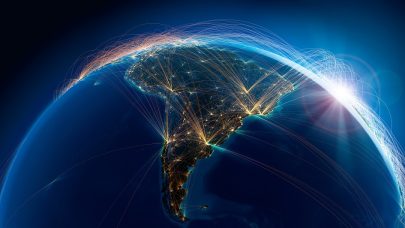
“Smart electric grids are measuring our homes’ use of power; active people are tracking their heart rates; and hundreds of millions of us are uploading geo-tagged data to Flickr, Yelp, Facebook and Google Plus. As we look 10 years ahead, the fastest supercomputer (the “exascale” machine) will be composed of one billion processors, and the clouds will most likely grow to this scale as well, creating a distributed planetary computer of enormous power.”
This unprecedented level of compute power, combined with the an equally vast storage system, will enable the analysis necessary for extracting meaningful intelligence from the torrent of incoming data. Research from the Institute for the Future shows that this global cloud computer will likely progress from simply collecting local data to being able to control it. “In this evolution,” writes Smarr, “the world gradually becomes programmable.”
There’s an apocryphal ring to this tale, but it’s a pretty straight-forward extrapolation of the current state of technology. Of course, any technological advance can be used for good or evil, a fact clearly illustrated by history. The good guys try to stay a step ahead of the bad guys; sometimes they fail, but for the most part it seems to work out. Smarr’s academic home, Calit2, is exploring specific “programmable world” scenarios, such as using sensors to monitor electricity consumption, while no doubt remaining acutely aware of the potential for misuse.