Datanami
 EnterpriseAI
 HPCwire Japan
 QCwire
 HPC & AI Wall Street
When we think about periods of massively disruptive technological innovations with a worldwide reach, dramatic shifts like the mainstreaming of the Internet or rapid innovations in medicine and genomics, for example, might come to mind.
To what degree could anyone have predicted the full impact of such innovations if they were only ever theories on paper—fleshed out but ultimately lifeless?
 This year at the European Future Technologies Conference in Budapest debate was focused on this exact kind of scientific fortune-telling. At the event the EU unveiled a massively-funded initiative to determine the next scientific or technological breakthrough for humankind via the Future and Emerging Technologies (FET) program.
For the members behind the two selected projects, the next decade will be quite a journey–both teams will receive at least 10 years of funding to the tune of 100 million Euros per year. There are six candidates in the running, but in 2012 only two will be granted funding for the next decade.
If one particular group is funded to see idea to come to fruition, however, it might be possible to evaluate the long-term historical impact of their work long before it’s even begun to unfold…at least that’s the theory.
We Are the World…Simulated
Among the six contenders is the futurICT (also called “Futurist”) initiative, which is led out of a number of European research centers—the two most prominent of which are in London and Zurich. In line with the epic scope of the initiative itself, the team behind futurICT has very big ideas—so big, in fact, that they will take a distributed supercomputing might that would parallel anything we’ve known to date.
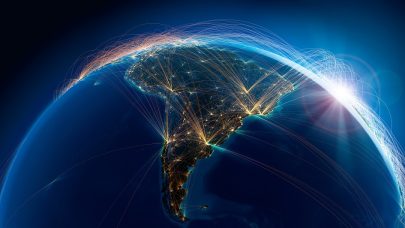
The group plans to develop “planetary-scale computing facilities” that can equip governments, scientists and ordinary people with a massive computational system the group calls the “Living Earth Platform”. In their vision, this platform “could provide a basis for predicting natural disasters or managing and responding to man-made disasters that cross national borders or even continents.”
From this description of the intent that has been circulating on the FET site and beyond, it might sound like the computer is meant to be some kind of Oracle to foretell dramatic events. However, as Paul Lukowitz from the University of Passau in Germany who is working on the project noted, the concept is far more complex—and far less about crystal balls or global fortune-telling.
In Lukowitz’s words, the project is about collecting data from things that are happening globally in real-time to run global-scale simulations of social systems. He notes, however, that this definitely requires a vast amount of computational might. As he described in a video interview from the FET event:
“Imagine that you want to run a simulation that has billions of agents, each corresponding to a single human being—then we want to feed that simulation with data which has been collected, optimally from all the Twitter feeds, mobile devices of billions of people and so on.”
In other words, this is near real-time analytics on an unprecedented scale with vast streams of massive data—no problem, right?
He notes that there are two big hurdles to this concept when considering this from a supercomputing or distributed computing angle.
One issue he address is how do you run such huge simulation—and not in batch mode—but in a way that will be interactively connected to people interacting with visualization, collaborating across the world—and then having models that are interconnected across different centers.
The other problem is, as he describes, “when you collect and evaluate data from billions of devices it’s about finding a coordinated distributed scheme for doing complex computations on data that are being collected across the world and then feeding that into the simulations.”
Leaving aside the computational problem for a moment (not to mention complications due to additional data this would kick up with all the associated emissions, new employment and general global “mood” changes caused by such a system) is another pesky problem—the idea will cost roughly $1.3 billion, according to a report in Technology Review.
And one more potential problem—real-time analytics are getting closer to everyday life than ever, with any number of institutions looking for the value in globally-amassed tweets, feeds, IMs and other networked communication. If the EU doesn’t decide to back the project—the world might be a much scarier place if someone else with a direct commercial interest does.
Better Living Through Science
The interview with Lukowitz was quite short; if he had another hour on film he probably still could not have found enough time to answer some of his own questions about the distributed supercomputing challenges ahea. However, he does simplify the idea by putting it in more practical context. In his view, this is very much like building a car—before you bother wasting time and resources building it, you make sure you test the idea via thorough modeling and simulation. He says, “we want to give people the possibility of running a global simulation of what the impact of a decision will be on the world—it’s the ultimate form of social engineering.”
The group claims that in addition to having the power to predict global events like the recent financial meltdown, “This platform will power Crisis Observatories, to detect and mitigate crises, and Participatory Platforms, to support the decision-making of policy-makers, business people and citizens, and to facilitate a better social, economic and political participation.”
Steve Bishop from University College in London said that if realized, this will create a future of “better decision making—no more going for pinball policy as we do now—we will be able to have a more rational set of choices for how we proceed in our lives.”
Some think this will be the major shift that sparks our transition to “Civilization 3.0” while others have compared the concept to Google Maps for society as “we’ve all played with the 3D map of the Earth that uses real data to reveal not only the town where you live and work but your home and back garden too…this is a similar model that uses, in real time, things like financial transactions, health records, travel details, carbon emissions and so on to build a model not just of the planet, but the entire society that populates it.”
It’s hard to tie in social engineering at this early stage as that is a payload we won’t see for at least ten years, but eventually, if such a platform existed to the degree the project leads hope, it could allow governments and others to tailor their responses to crises or major policy decisions. How all of this will predict natural disasters, as the group claims here, is still a bit of a mystery, but we can always hold out hope for a modern day incarnation of the Oracle at Delphi.
*By the way, if some of this concept sounds a little familiar, you might be right.